
Political Science
The Comparison of Women in Student Government versus American Government
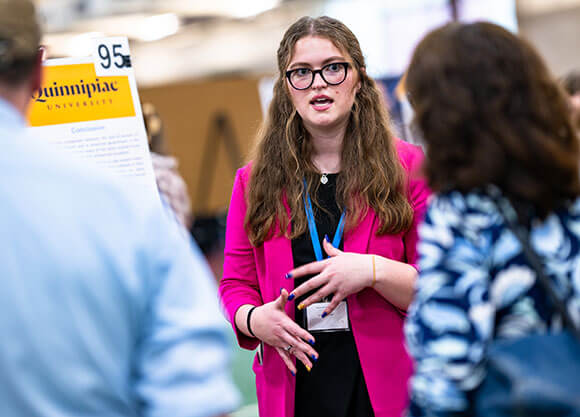
Political Science
The Comparison of Women in Student Government versus American Government
This project examines the relationship between the opportunities women have in student government versus their roles in the American government and how it may impact how they see themselves when entering the working world. This project was created for the course PO 408: Senior Seminar.
Overview
Since the lack of women in leadership positions is a problem that plagues both structures, this thesis explored the connection between them. It found that they share many core problems, while also impacting each other. Student government provides professional development that prepares future leaders, but it’s difficult for young women to see themselves as leaders when they aren’t reflected in their country’s government. Based on these findings, it would be beneficial to re-examine the way that leadership is defined and valued in America.
Researcher

Jamison Setzler '25
Political Science
College of Arts & Sciences - School Name
From Residence Halls to National Malls: The Relationship Between Women in Student Government and Women in American Government
Abstract
Although women have been participating in higher education and exercising their right to vote for over a century, their representation in leadership roles — both within collegiate student government and American government — lags behind that of men in similar positions. Since the lack of women in leadership positions is a problem that plagues both structures, this thesis explored the connection between them. It found that they share many core problems, while also impacting each other. Student government provides professional development that prepares future leaders, but it’s difficult for young women to see themselves as leaders when they aren’t reflected in their country’s government. Based on these findings, it would be beneficial to re-examine the way that leadership is defined and valued in America.
Introduction
Despite the de jure equal access that women have to collegiate student governments and to American government, the number of women involved in these institutions is not representative of the population. These discrepancies have been studied by scholars in the respective fields of student affairs and political science, but there has been very limited exploration into how these two phenomena interact with each other. Thus, this thesis explores the relationship between the lack of women in student government and the lack of women in American government.
Literature Review
Within formal, American government, scholars have given three primary explanations for the lack of female leaders: socio-structural, culture-based, and institution-based (Ahn et al 2019). While the socio-structural explanation have been found largely inaccurate in modern research, scholars give the latter two theories varying amounts of credit (Ahn et al 2019). Studies found that Americans often held stereotyped beliefs about men and women in politics, but it is unclear the extent to which this may disadvantage women when running for office (Ahn et al 2019; Bauer 2013; Dolan 2014). However, cultural attitudes about leadership qualities, historically “feminine” or “masculine” traits, and the way that women are socialized can instill them with low political self-efficacy (Ahn et al 2019; Dolan 2014; Bauer 2013; Workman et al 2020). Lastly, the institution-based explanation is the most well-regarded theory among scholars, as it posits that party gatekeepers add significant barriers for women trying to break into elected politics (Ahn et al 2019).
Within student government, scholars credited the “boys club” culture of these spaces for creating an environment that women aren’t welcomed in (Workman et al 2020). In part because of this culture, research also found that women are less likely to run for student government (Workman et al 2020). This is also attributed to the fact that women are socialized not to advocate for themselves, they lack role models who resemble them, and they often have different values or goals that don’t align with the work done by their SG (Ely et al 2011; Haber-Curran and Tillapaugh 2017; Iverson et al 2019; Miller and Kraus 2004, Smith 2015). Lastly, some scholars believe that women may be less likely to win elections, even when they do run, because of inherent bias and the fact that they rarely fit society’s image of what a leader looks and acts like (Ely et al 2011; McNaughtan et al 2024; Iverson et al 2019; Smith 2015).
Approach
Hypothesis: The lack of representation in American government hinders female students’ ability to see themselves as leaders, but without the professional development offered by student government involvement, women have a more strenuous path to political careers, resulting in a cyclical relationship between the two phenomena.
Theories:
- Symbolic Representation Theory: Women in government serve as symbols that female leadership is attainable
- Pipeline Theory: Student Government provides professional development that prepares students for legitimate government
Methods: Evidence was primarily gathered through synthesizing existing literature on the separate topics of student government and American government. Primary sources were utilized to gather information about the student government history of elected officials.
Parameters:
- "Student Government" or "SG" will be used loosely to refer to any organization comprised of students who were elected to represent the student body at their college or university.
- Not all aspects of American government are being studied in this thesis. The focus will primarily be on Presidential, Congressional, and Gubernatorial positions.
Findings
Common Obstacles:
- Subconscious bias against women
- Women are less tolerant towards their own mistakes
- Women’s credibility is often called into question
- Women feel inclined to work harder to be taken seriously
- The male-dominated culture is unwelcoming
- Women are held to a higher standard
- Stereotyped ideas of what a leader is
- Girls aren’t socialized to see themselves as leaders
- Women are less likely to see themselves as qualified
- Absence of female mentors/network
Student Government Obstacles
- Lack of proper transition
- Working with primarily male administrators
- Women are more likely to run when encouraged
- Women have different goals and values
Formal Government Obstacles
- Incumbency advantage
- Party gatekeepers
- Balancing work and family life
- When women serve in governmental positions, it shows other women that they can be leaders as well
- Women being in leadership positions provides society the means to reimagine their ideas of what a leader is
- Student government provides opportunities for students to gain valuable experiences and skills
- Over 1/5 of women currently serving as a senator or a governor have prior SG involvement (see Figure 1)
- Kamala Harris and Hillary Clinton — the only two women to ever receive a presidential nomination — both participated in student government in college
- Not all student government membership is well-documented and not all political figures have had their collegiate activities reported on, especially if they are newer to politics
Conclusion
- The strongest connection between the lack of women in student government and in American government is the fact that they stem from many of the same societal issues — most notably, the way that women are socialized
- Having few female leaders to look to as role models makes it more difficult for other women to feel confident in their leadership abilities. However, this applies to other leadership positions as well and universities having female administrators has a similar impact
- While SG provides undeniable professional development, there was insufficient evidence to conclusively support the idea that a lack of student government experience creates barriers for women pursuing politics
Women in student government and women in American government face many of the same problems and the lack of women in government has an impact on the amount of female student leaders. There is a relationship between these two phenomena, but they both have other factors impacting them as well.
Future Directions
- More thorough research into SG history, potentially through contacting members of Congress directly with inquiries
- Restructuring leadership development to be more inclusive and value a greater number of traits
- Making efforts to empower women and encourage them to pursue leadership opportunities
For Further Discussion
This serves as an overview of the project and does not include the complete work. To further discuss this project, please email Jamison Setzler.
Course Overview
PO 408: Senior Seminar is a capstone course for senior political science majors. Students integrate prior learning with a seminar topic announced each year, and prepare and present original research to their peers in the form of a senior thesis, related to a common seminar theme announced each year. The seminar allows students to apply the knowledge and methodology they have learned in previous courses to a particular project.
Explore Our Areas of Interest
We've sorted each of our undergraduate, graduate and doctoral programs into unique Areas of Interest. Explore these categories to discover which programs and delivery methods best align with your educational and career goals.
Explore Law and Public Policy at Quinnipiac
Explore Social Sciences at Quinnipiac
References
Bauer, Nichole M. 2013. “Rethinking Stereotype Reliance: Understanding the Connection between Female Candidates and Gender Stereotypes.” Politics and the Life Sciences 32 (1): 22–42. http://www.jstor.org/stable/43287266.
Iverson, Susan V., Brenda L. McKenzie, and Malina Halman. 2019. “What Can Feminism Offer Student Leadership Education?” Journal of Leadership Education. 18 (1): 183-199. https://doi.org/10.12806/V18/I1/T1.
Workman, Jamie L., Karla Hull, Taralynn Hartsell, and Teresa Weimann. 2020. “A Chilly Climate: Experiences of Women Student Government Association Presidents.” Journal of Campus Activities Practice and Scholarship 2 (1): 39–54. https://research.ebsco.com/linkprocessor/plink?id=dbbe632f-3846-3153-bad1-56ec207cce24.