
Political Science
Gods and Governments
Political Science
Gods and Governments
For her senior thesis, Palek Singh ’24 focused on the construction of religious minorities in India and Pakistan. From a comparative analysis of both nations, she found that the negative representation of religious minority communities is deployed through the school educational curriculums and rhetoric used by key political leaders. These main contributors work together to perpetuate and eternalize a divide between Hindus, the religious majority in India, and Muslims, the religious majority in Pakistan.
Overview
From a comparative analysis of both nations, Palek Singh ’24 found that the negative representation of religious minority communities is deployed through the school educational curriculums and rhetoric used by key political leaders.
Author
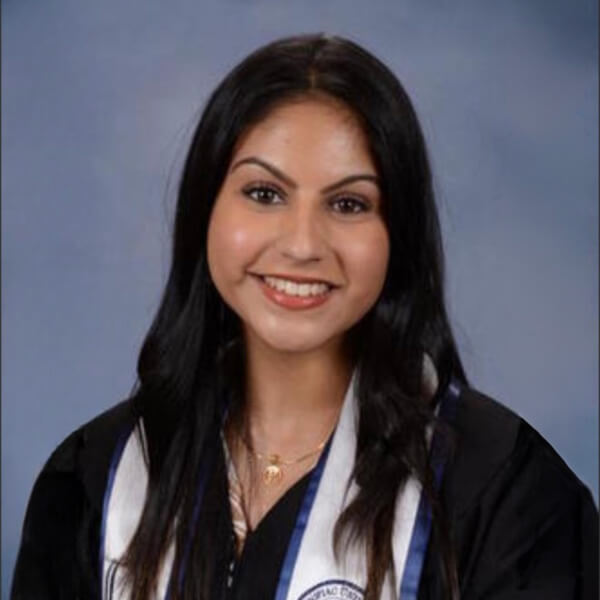
Palek Singh '24
Political Science
College of Arts & Sciences - School Name
Gods and Governments: The Construction of Religious Minorities in India and Pakistan
Introduction
The age-old rivalry and struggle between Hindu-majority India and Muslim-majority Pakistan was not a matter of nationality or land occupation, it was a deeper-rooted conflict about religion and identity. The continuance of this conflict is evident in the construction of Hindu minorities in Pakistan and Muslim minorities in India.
India and Pakistan are two different countries, India is a secular state intended to keep religion separate from the government, and Pakistan is distinctly a non-secular state that puts Islam at the forefront of government. Nonetheless, it's important to acknowledge that religious nationalism and influence can be exerted whether or not a country is secular, and this significantly impacts religious minorities. These minorities are often sidelined or "othered" because they don't identify with the dominant religion.
Therefore, this thesis is a comparative study of the two nations that attempts to examine how the construction of Muslims in India and Hindus in Pakistan continues to perpetuate a political and social divide between the two religious groups today.
Methods
The data collection will consist of qualitative research. Since this a comparative study, the data will reflect the problematic structures of both countries.
The construction will be studied through India and Pakistan's educational curriculum, specifically the history textbooks used in schools. The focus will be on highlighting the distortion and biased knowledge in each country and how they work together to create the "us vs them" mentality and portray religious minorities in a negative light. Another comparison will be of the Hindu nationalist rhetoric used by India's Prime Minister, Narendra Modi, and the Islamist rhetoric used by members of Pakistan's political party, the Pakistan Muslim League-Quaid (PML-Q).
An examination of these two outlets will in turn detail how the political and social divide is projected through popular media, for example, in films.
Findings
Examples of the tone and language used in 9th- grade Pakistan studies textbooks:
- "Pakistani textbooks fail to acknowledge and celebrate religious diversity and instead entrench Muslim majoritarian views in ways that alienate religious minority pupils" (Ali & Mukherjee 2022).
Examples of Narendra Modi's rhetoric in his speeches and responses:
- Modi reacted to the controversy under the 2023 Indian film called "The Kerala Story" claimed by many to portray Muslims in a negative light and to divide Hindus and Muslims in India. He stated in a public speech that he supported the film and that it revealed "the ugly truth of terrorism."
Analysis
The excerpts from the Pakistani textbooks display biased language. They offer a single point of view that constructs Hindus as the enemy and the ones responsible for the suffering of Muslims and Pakistanis. The same tone and language are present in Indian textbooks as well. These textbooks perpetuate a political and social divide today because educating young minds to think a certain way becomes political propaganda. Since this knowledge is engrained so early into students' minds, it is harder to abandon those beliefs as they grow up and continue to widen the divide between Muslims and Hindus.
When asked about the rights of Muslims in India, Prime Minister Modi responds by explaining what democracy is and how discrimination cannot occur in a democracy.
However, what is stated on paper and in the Constitution does not always reflect the actions of political leaders. This is evident even in a first-world country like the
U.S. Therefore, Modi's response failed to answer the reporter's question since he did not address Muslims or other religious minorities but instead spoke about democracy. Modi's rhetoric perpetuates a political and social divide because he makes no effort to unify all religious groups residing in India. Instead, the concerns of minority rights go ignored as depicted in Modi's response to the reporter or the divide is further fueled as depicted in Modi's reaction to the controversial Indian film.
Professional Application
"As an aspiring attorney starting law school this fall, I believe it’s crucial for me to understand and consider all perspectives of a story. An attorney has to be prepared to engage in conversation and refute points the opposing counsel may posit. Therefore, conducting a comparative study of India and Pakistan allowed me to set aside my own biases and acknowledge that prejudice and discrimination exist on both sides. By doing this form of research, I believe I’m more informed on the topic and region than I was before." - Palek Singh ’24
For Further Discussion
This serves as an overview of the project and does not include the complete work. To further discuss this project, please email Palek Singh.
Course Overview
PO 408: Senior Seminar is the capstone course for political science majors. Students integrate prior learning with a seminar topic announced each year, and prepare and present original research to their peers in the form of a senior thesis, related to a common seminar theme announced each year. The seminar allows students to apply the knowledge and methodology they have learned in previous courses to a particular project.
Explore Our Areas of Interest
We've sorted each of our undergraduate, graduate and doctoral programs into unique Areas of Interest. Explore these categories to discover which programs and delivery methods best align with your educational and career goals.