
Nursing
The Intersection of Public Policy, Food Access, and Chronic Disease
Nursing
The Intersection of Public Policy, Food Access, and Chronic Disease
This project explores the complex and cyclical relationship between food insecurity and chronic disease as a Wicked Problem in public health. This project was created for the course NUR 454: Nursing Capstone.
Overview
This project explores the complex and cyclical relationship between food insecurity and chronic disease as a Wicked Problem in public health. Drawing from policy and economic perspectives, it highlights how systemic barriers such as food deserts, underfunded nutrition programs, and socioeconomic inequities contribute to poor health outcomes in vulnerable populations. My work emphasizes the need for multisector collaboration, policy reform, and a shift toward nutritional equity to interrupt this cycle and reduce long-term healthcare and economic burdens.
Researcher

Colin MacDonald '25
Nursing
School of Nursing
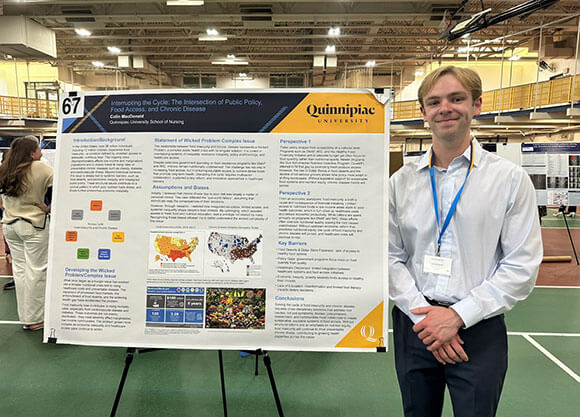
Interrupting the Cycle: The Intersection of Public Policy, Food Access, and Chronic Disease
Introduction/Background
In the United States, over 38 million individuals, including 12 million children, experience food insecurity—a condition defined by uncertain access to adequate, nutritious food. This ongoing crisis disproportionately affects low-income and marginalized populations and is closely linked to rising rates of preventable chronic diseases such as obesity, diabetes, and cardiovascular illness. Beyond individual behavior, this issue is deeply tied to systemic barriers, such as food deserts, socioeconomic inequity, and misaligned public policy. These structural issues contribute to a cyclical pattern in which poor nutrition fuels illness, and illness further entrenches economic instability (Shrider, 2023).
Developing the Wicked Problem/Complex Issue
What once began as a hunger issue has evolved into a broader nutritional crisis tied to rising healthcare costs and preventable disease. The expansion of processed food markets, the entrenchment of food deserts, and the widening wealth gap have accelerated the problem.
Food insecurity now contributes to rising mortality rates, especially from cardiovascular disease and diabetes. These outcomes are not evenly distributed—they most severely affect marginalized, low-income communities. The problem grows more complex as economic inequality and healthcare access gaps continue to widen.
Statement of Wicked Problem Complex Issue
The relationship between food insecurity and chronic disease represents a Wicked Problem, a complex public health crisis with no singular solution. It is rooted in overlapping systems of inequality: economic instability, policy shortcomings, and healthcare access.
Despite extensive government spending on food assistance programs like SNAP and WIC, millions remain nutritionally underserved (House Budget Committee, 2023). The challenge lies not only in increasing food access, but in ensuring equitable access to nutrient-dense foods that promote long-term health. Disrupting this cycle requires multisector collaboration, sustained policy reform, and innovative approaches in healthcare delivery.
Assumptions and Biases
Initially, I believed that chronic illness due to poor diet was largely a matter of personal choice. This view reflected the “just-world fallacy”, assuming that individuals reap the consequences of their decisions.
However, through research, I realized how misguided education, limited access, and systemic inequality shape people’s food choices. My upbringing, which included access to fresh food and nutrition education, was a privilege not shared by many. Recognizing these biases allowed me to better understand the wicked complexity of this issue.
Perspective 1
Public policy shapes food accessibility at a national level. Programs such as SNAP, WIC, and the Healthy Food Financing Initiative aim to alleviate hunger, yet often focus on food quantity rather than nutritional quality. Newer programs like GusNIP (Gus Schumacher Nutrition Incentive Program) attempt to fill that gap by promoting fresh produce access. However, the rise of Dollar Stores in food deserts and the decline of full-service grocers shows how policy must adapt to shifting landscapes (Chenarides et al., 2021).Without legislative support for sustainable food systems and nutrition equity, chronic disease trends will persist.
Perspective 2
From an economic standpoint, food insecurity is both a cause and consequence of financial instability. Limited access to nutritious foods in low-income areas leads to poor health outcomes, which in turn drive up healthcare costs and reduce economic productivity. While billions are spent annually on programs like SNAP and WIC, these efforts often overlook nutritional quality, leaving the root causes unaddressed. Without upstream economic reform that prioritizes nutritional equity, the cycle of food insecurity and chronic disease will persist, and healthcare costs will continue to rise (Dicken et al., 2021).
Key Barriers
- Food Deserts & Dollar Store Expansion: Lack of access to healthy food options.
- Policy Gaps: Government programs focus more on food quantity than quality.
- Healthcare Disconnect: Limited integration between healthcare systems and food access initiatives.
- Economic Inequity: Poverty heavily restricts the ability to make healthy food choices.
- Lack of Education: Misinformation and limited food literacy impact dietary decisions.
Conclusions
Solving the cycle of food insecurity and chronic disease requires cross-disciplinary solutions that address root causes, not just symptoms. Nurses, policymakers, researchers, and communities must collaborate to create sustainable, equitable systems of food access. Without structural reform and an emphasis on nutrition equity, food insecurity will continue to drive preventable chronic illness, contributing to growing health disparities across the nation.
For Further Discussion
This serves as an overview of the project and does not include the complete work. To further discuss this project, please email Colin MacDonald.
Course Overview
NUR 454: Nursing Capstone provides a framework within which the student intentionally reflects upon and integrates the experiences that represent the meaning of their collegiate learning. Each student designs a final signature work, which demonstrates a scholarly representation of those experiences.
Explore Our Areas of Interest
We've sorted each of our undergraduate, graduate and doctoral programs into unique Areas of Interest. Explore these categories to discover which programs and delivery methods best align with your educational and career goals.