
Interdisciplinary
Cells Support Intracellular Replication of Coxiella burnetii
Interdisciplinary
Cells Support Intracellular Replication of Coxiella burnetii
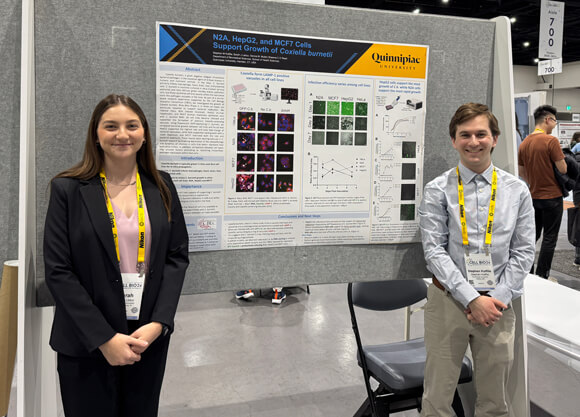
This study was conducted to highlight the first known cases of Coxiella Burnetti in N2A, HepG2, and MCF7 cells. The group's findings will allow future comparative studies of C. Brunetti and infection dynamics in different cell types.
Overview
This project expands the understanding of Coxiella Burnetii, the bacterial pathogen that causes Q fever in humans, by examining its replication in N2A, HepG2, and MCF7 cells. Instead of testing using traditional cells such as HeLa and Vero, this project uses different cell types to further comparative studies of C. Burnetti cytopathology and infection dynamics
Student Researchers
Stephen Kotfila '25
Medical Microbiology and Immunology
School of Health Sciences

Sarah Leduc ’24, MHS '25
Biomedical Sciences
School of Health Sciences
N2A, MCF7, and HepG2 Cells Support Intracellular Replication of Coxiella burnetii
Abstract
Coxiella burnetii, the causative agent of query fever (Q fever), is a gram-negative, intracellular bacterial pathogen. Though an obligate intracellular bacteria, C. burnetii can be grown in axenic culture in specialized media or can be propagated in vitro using cultured cell lines. There is prolific literature describing C. burneti growth in well-defined cell lines such as Hela and Vero cells. These cells, however, create conditions distinct from C. burnetii's ecological niche within the host. C. burnetii, in the host, infects macrophages as well as heart, brain, liver, and placental tissue. We are investigating whether C. burnetii will grow in the following cell lines: N2A (mouse neuronal), HepG2 (human hepatocyte), MCF7 (human mammary epithelial), and HEX293T (human embryonic kidney). This will be accomplished by erowine the cell lines stated above, plating them, and then inoculating them with Coxiello burneti. Then, the cells will be imaged, harvested, and C. burnetii DNA will be extracted and quantified from inoculated cells. We anticipate that a Coxie la containing vacuole (CCV) will be observed in HEK293T cells, N2A cells, and HepG2 cells, and may be observed in MCF7 cells. identifying new cell lines capable of supporting C. burnetii growth wil enable researchers to explore the cytopathology of C. burnetii infections in cells that better represent their ecological niche and expand the repertoire of available cell fines for C. burnetii growth.
Faculty Researcher and Mentor
For Further Discussion
This serves as an overview of the project and does not include the complete work. To further discuss this project, please email Shawna Reed.
Course Overview
BMS 481: Research Techniques in Biomedical Sciences is a laboratory course designed around learning the basic principles of a research technique in the context of a faculty member's research. Students will learn how the method works, gain technical proficiency leading to independence, and practice professional scientific communication through analysis and interpretation of original data.
Explore Our Areas of Interest
We've sorted each of our undergraduate, graduate and doctoral programs into unique Areas of Interest. Explore these categories to discover which programs and delivery methods best align with your educational and career goals.
Explore Health and Medicine at Quinnipiac