
Nursing
The Fatal Gender Bias in Cardiac Arrest Response
Nursing
The Fatal Gender Bias in Cardiac Arrest Response
This capstone utilizes peer-reviewed research to examine how gender bias in cardiopulmonary resuscitation (CPR) contributes to higher mortality rates among women experiencing cardiac arrest. This capstone was created for the course NUR454: Nursing Capstone.
Overview
Cardiac arrest does not discriminate, but emergency response does — and it's killing women. This capstone utilizes peer-reviewed research to examine how gender bias in cardiopulmonary resuscitation (CPR) contributes to higher mortality rates among women experiencing cardiac arrest. Despite equal biological need, women are significantly less likely to receive bystander CPR due to fear of inappropriate physical contact, hesitation to expose female chests, and lack of training on female-bodied mannequins. In clinical settings, diagnostic delays and misconceptions about “atypical” symptoms further reduce women’s survival rates. By exploring gaps in public perception, medical education, and institutional practice, this project presents a troubling new perspective on cardiac caregiving.
Student Team

Kiera Hines '25
Nursing
School of Nursing
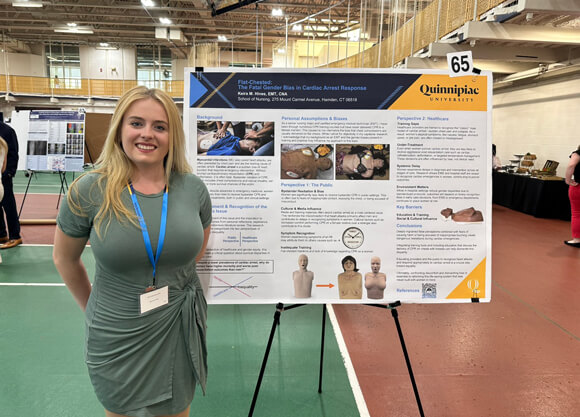
Flat-Chested: The Fatal Gender Bias in Cardiac Arrest Response
Background
Myocardial infarctions (MI), also called heart attacks, are often preceded by chest pain and are the leading cause of cardiac arrest. Cardiac arrest is a sudden loss of heart function that requires emergency intervention. Without prompt cardiopulmonary resuscitation (CPR) and defibrillation, it is often fatal. Bystander initiation of CPR, which includes chest compressions and rescue breaths, can double or triple survival chances of the victim.
However, despite advances in emergency medicine, women are less likely than men to receive bystander CPR and aggressive treatments, both in public and clinical settings.
Development & Recognition of the Complex Issue
The development of this issue and the inspiration to investigate comes from personal reflections, experience, and a comprehensive literature review. The research findings were categorized into two perspectives of overarching inequality: the public perspective and the healthcare perspective.
At the intersection of healthcare and gender equity, this issue raises a critical question about survival disparities in cardiac care:
“Despite a lower prevalence of cardiac arrest, why do women have higher mortality and worse postresuscitation outcomes than men?”
Personal Assumptions & Biases
As a senior nursing major and certified emergency medical technician (EMT), I have been through numerous CPR training courses but have never delivered CPR to a female manikin. This caused to me internalize the bias that chest compressions are usually delivered on flat chests. While I strive for objectivity in my capstone research, I acknowledge that my background as an EMT and the gender biases present in training and practice may influence my approach to this topic.
Perspective 1: The Public
Bystander Hesitation & Bias
Women are significantly less likely to receive bystander CPR in public settings. This is often due to fears of inappropriate contact, exposing the chest, or being accused of misconduct.
Cultural & Media Influence
Media and training materials often depict cardiac arrest as a male-centered issue. This reinforces the misconception that heart attacks primarily affect men and contributes to delays in recognizing symptoms in women. Cultural factors such as increased comfort performing CPR on a female relative over a stranger also contribute to this divide.
Symptom Recognition
Women experiencing symptoms of an MI may attribute them to others causes such as family, fatigue, indigestion, and stress.
Inadequate Training
Flat-chested manikins and lack of knowledge regarding CPR on a woman.
Perspective 2: Healthcare
Training Gaps
Healthcare providers are trained to recognize the “classic” male model of cardiac arrest—sudden chest pain and collapse. As a result, women’s atypical symptoms, like nausea, fatigue, stomach upset, or jaw pain, are often missed or misdiagnosed.
Under-Treatment
Even when women survive cardiac arrest, they are less likely to receive aggressive post-resuscitation care such as cardiac catheterization, defibrillation, or targeted temperature management. These decisions are often influenced by bias, not clinical need.
Systemic Delay
Women experience delays in diagnosis and intervention across all stages of care. Research shows EMS and hospital staff are slower to recognize cardiac emergencies in women, contributing to poorer outcomes.
Environment Matters
While in-hospital settings reduce gender disparities due to standardized protocols, outcomes still depend on timely recognition. Bias in early care decisions, from EMS to emergency departments, continues to place women at risk.
Key Barriers
- Education & Training
- Social & Cultural Influence
Conclusions
Deeply ingrained false perceptions combined with fears of causing harm or being accused of inappropriate touching create dangerous hesitations during cardiac emergencies.
Integrating training tools and including education that discuss the delivery of CPR on chests with breasts can help dismantle this disparity.
Educating providers and the public to recognize heart attacks and respond appropriately to cardiac arrest is a crucial step toward equality.
Ultimately, confronting discomfort and dismantling bias is essential to reforming this life-saving system that was never built with women in mind.
Professional Application
"This project has deepened my understanding of how gender bias can affect critical health outcomes and has strengthened my ability to approach care through an equity-focused lens. By analyzing disparities in cardiac arrest response, I’ve learned how systemic issues in training, public perception, and clinical practice can have life-or-death consequences. As I enter the nursing profession, this project has prepared me to advocate for inclusive education, recognize implicit bias in emergency care, and promote patient-centered interventions that prioritize safety and fairness for all." - Kiera Hines '25
For Further Discussion
This serves as an overview of the project and does not include the complete work. To further discuss this project, please email Leonile Scott.
Course Overview
NUR 454: Nursing Capstone provides a framework within which the student intentionally reflects upon and integrates the experiences that represent the meaning of their collegiate learning. Each student designs a final signature work, which demonstrates a scholarly representation of those experiences.
Explore Our Areas of Interest
We've sorted each of our undergraduate, graduate and doctoral programs into unique Areas of Interest. Explore these categories to discover which programs and delivery methods best align with your educational and career goals.