
Gerontology
Where You Live Matters
Gerontology
Where You Live Matters
There are many misconceptions about the aging experience throughout the United States and abroad. Many assume that older adults will automatically become frail and senile just because they are moving through the life course. The focus of this project will be to analyze the intersection of health behaviors, health literacy, healthcare access and utilization and the effects on the quality of life of older adults aged 65 and older in the State of Connecticut.
Overview
This research proposal aims to explain how health literacy, health behaviors, preventative health care access and utilization, and how they influence quality of life in older adults.
Author
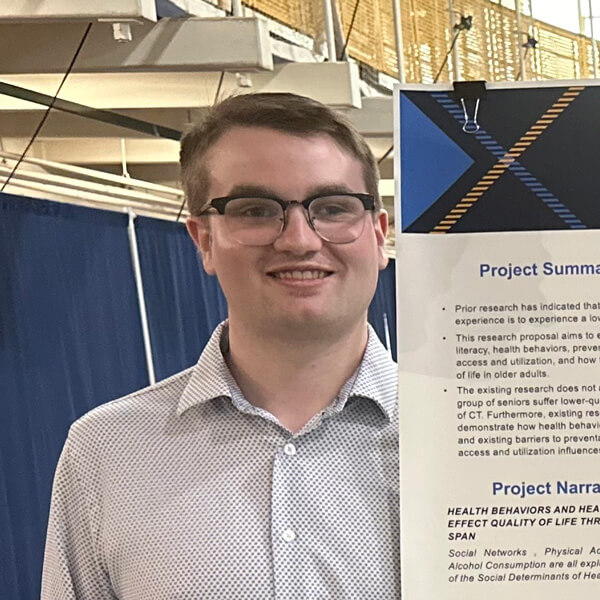
Kevin Clark '24
Gerontology
College of Arts & Sciences - School Name
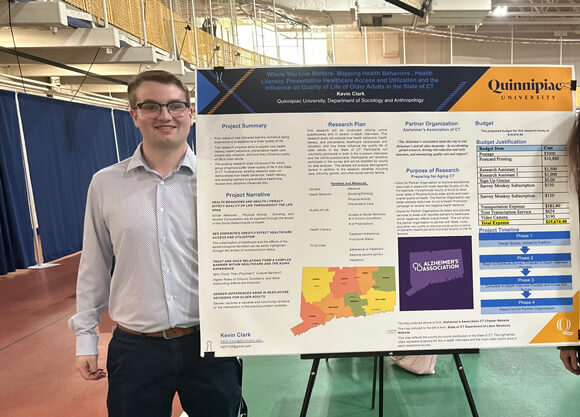
Where You Live Matters: Mapping Health Behaviors, Health Literacy, Preventative Healthcare Access, and the Influence on Quality of Life on Older adults in the State of CT
Project Summary
Prior research has indicated that the normative aging experience is to experience a lower quality of life. The existing research does not account for which group of seniors suffer lower-quality of life in the State of CT. Furthermore, existing research does not demonstrate how health behaviors, health literacy, and existing barriers to preventative healthcare access and utilization influences quality of life (QoL).
This research proposal aims to explain how health literacy, health behaviors, preventative health care access and utilization, and how they influence quality of life in older adults.
Project Narrative
Health Behaviors and Health Literacy Effect Quality of Life Throughout the Life Span
- Social networks, physical activity, smoking, and alcohol consumption are all explored through the lenses of the social determinants of health.
SES Disparities Greatly Effect Healthcare Access and Utilization
- The urbanization of healthcare and the effects of the epidemiological transition can be easily highlighted through the lenses of socioeconomic status.
Trust and Race Relations Form a Complex Barrier Within Healthcare and the Aging Experience
- Who trusts their physician? What are cultural barriers? Higher rates of chronic conditions and more astounding effects are explored.
Gender Differences Arise in Healthcare Decisions for Older Adults
- Gender captures a valuable and convincing narrative of the intersection of the previous project variables.
Purpose of Research: Preparing for Aging CT
Partner Organization: Alzheimer’s Association of CT
- Allows for Partner Organization to improve educational resources in areas with lower reported quality of life. For example, if a particular county is found to have lower rates of physical activity older adults and lower overall quality of health. The Partner Organization can better allocate resources to run a health promotion campaign to reverse the negative health behavior.
- Allows for Partner Organization to obtain and allocate services to areas with reported barriers to healthcare which negatively affects overall health. This will allow the partner organization to partner with state, local, and other non-profits to improve social policy in terms of geriatric healthcare and improved quality of life for seniors.
Research Plan
This research will be conducted utilizing online questionaries and in person in-depth interviews. This research study will analyze how health behaviors, health literacy, and preventative healthcare care/access and utilization, and how these influence the quality life of older adults in the State of CT. Participants will voluntarily participate in both in the in-person interviews and the online-questionnaire. Participants will randomly participate in the survey and will be stratified by county for data analysis. The sample will analyze demographic factors in addition to the research variables including race, ethnicity, gender, and other social identity factors.
Variables and Measures
Health Behavior
- Smoking/Drinking
- Physical Activity
- Preventative Care
Quality of Life
- Access to Social Networks
- Number of Chronic Conditions
- Number of Prescriptions
Health Literacy
- Treatment Adherence
- Functional Status
Trust Index
- Adherence to Treatment
- Seeking Second Opinion
- Hesitancy
Project Timeline
Phase I (October 2024 - January 2025)
- Phase I of this project will require researchers to gather the State of CT General Election Registration data. In addition to this, the research team will begin to design the postcard with the QR Code for the online survey. The online survey will be launched, and the project will commence when postcards are mailed to the samples home address.
Phase II (February 2025 - March 2025)
- Phase II of this project will involve finalize steps to conduct in depth interviews. Additionally, the researchers will continue to monitor the online survey data as it becomes available.
Phase III (April 2025)
- Phase III of this project will see the survey close for responses. Additionally, in-depth interviews will stop being conducted. When the in-depth interviews stop being conducted, the transcription process will immediately follow. Two in-depth interviews will be conducted each week in locations across the State of Connecticut. Each interview site will have 20 participants.
Phase IV (May 2025 - July 2025)
- Phase IV of this project will commence when researchers begin to analyze results of the online questionaries and begin to analyze them in conjunction with the completed transcriptions of the video recorded in-depth interviews. The target date for the research publication will be July 30, 2025.
Professional Application
"My primary inspiration for this project is rooted in my desire to work with the senior population. After graduation, I joined Brightview Senior Living, so I wanted to do something that related to the health and well-being of seniors since that is such an important part of the work that I am committing my life too. Additionally, after reading a few research articles, it was clear to me that there wasn't a lot of research on the senior population and why seniors are experiencing longevity, yet this longevity is now being coupled with a lower quality of life. This research grant proposal aims to trying to understand the root causes of this gap, which the thesis attributes to health behaviors, health literacy and preventative healthcare access and utilization." - Kevin Clark ’24
For Further Discussion
This serves as an overview of the project and does not include the complete work. To further discuss this project, please email Kevin Clark.
Course Overview
GT 400: Senior Seminar is designed as the capstone course for students majoring in sociology and gerontology. Students research a sociological or aging-related topic of their choosing and write a thesis based on their work. All senior theses represent a culmination of majors' academic experiences in the department.
Explore the Social Sciences Area of Interest
We've sorted each of our undergraduate, graduate and doctoral programs into unique Areas of Interest. Explore these categories to discover which programs and delivery methods best align with your educational and career goals.